

Wd My Cloud Home Vs Mirror
At a Glance
Expert'south Rating
Pros
- RAID ane provides information security
- Tin back up to other WD NAS boxes
- Very easy to fix and utilise
Cons
- Cannot sync with other WD NAS boxes
- Moderately slow performance
Our Verdict
WD's My Cloud Mirror doesn't deliver barn-burning operation, but it'due south very easy to set up and use and it delivers most everything you could want in a consumer NAS box.
I liked Western Digital's My Cloud network-attached storage device when I reviewed it tardily final twelvemonth, but relying on a single-drive NAS can be risky. If that drive fails, and you don't have a backup, y'all could lose all your information—forever.
WD'southward My Cloud Mirror solves that problem by putting a second drive in the same enclosure, and configuring the drives as RAID 1. All the same information is written to both drives, then that if one drive fails, yous can recover everything from the other.
The model reviewed here came with two 2TB drives, yielding 2TB of storage (not 4TB, because the drives are in RAID 1). At that place's nothing to cease you from reconfiguring the drives in RAID 0 for blinding speed and 4TB of storage, only that would throw your data-redundancy strategy right out the window. I wouldn't recommend that unless y'all're admittedly captious about backing upwards your NAS—and nobody is fastidious enough to avoid Murphy's Law.
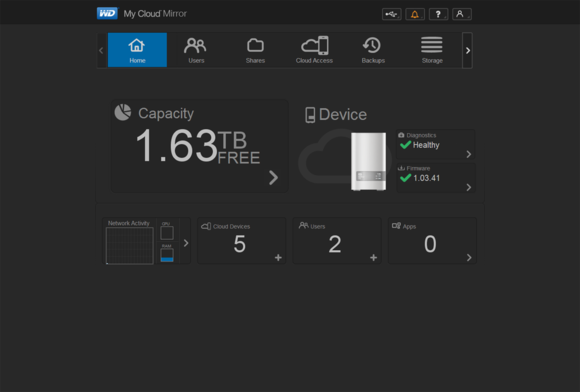
The My Deject Mirror's user interface is well laid out and easy to sympathise. You'll need the user manual only for some of its more advanced features.
The My Cloud Mirror will as well let you lot back up its contents to another storage device via its USB 3.0 port, but an even amend data security strategy would exist to deploy a 2d My Cloud Mirror (or a My Cloud EX2 or EX4, only it must be a Western Digital device) at a remote location and back up the contents of each drive to the other (you lot can too do this over your local network, but that's not as safe as having backups at different physical locations).
If y'all don't want to go either of those routes, WD'southward software volition allow you lot support your My Cloud Mirror to the deject (using either your ElephantDrive or Amazon S3 account, though you'll need to pay for whichever service you choose). What information technology won't let you practise is support a customer to the My Deject Mirror itself over an Internet connection; the customer must be attached to the same local network as the My Deject Mirror.
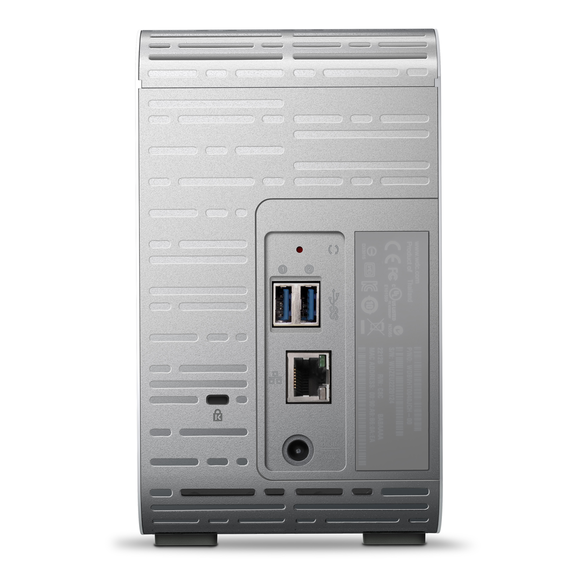
You can use the USB 3.0 ports for backup (to or from the My Cloud Mirror) or for additional storage (fastened drives will announced every bit shares on the dashboard).
Unlike a Dropbox account (or Continued Data's Transporter line), which maintain a binder on your local device that is synchronized with your cloud storage, files are stored only on the My Cloud device. The benefit to this approach is that you don't consume the limited storage on your device. The drawback is that yous need to have Internet access to be able to retrieve your files.
As with the original My Deject, Western Digital is marketing the My Cloud Mirror to consumers, and this box has most of the features that audience volition want. At that place's an integrated FTP server, for example, and peer-to-peer file-sharing (BitTorrent). Finally, at that place a number of apps you tin run right on the box, including Joomla and WordPress, if you want to host your own website.
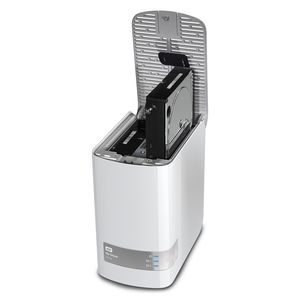
The drives within the My Deject Mirror are very easy to access without tools.
Western Digital populates the My Deject Mirror with its own WD Reddish drives, which are designed for 24/vii operation. The balance of the box'due south hardware features tilt toward consumer more SMB. Different the more robust My Cloud EX series, this box has just one gigabit Ethernet interface and ane power connector, so at that place's no failover protection on either count.
Consumers volition appreciate the My Cloud Mirror's simple graphical user interface, which makes this automobile very easy to gear up. It comes from the manufactory with both iTunes and DLNA media servers for streaming media to PCs, smart TVs, mobile devices (smartphones and tablets), and media-streaming boxes in your abode. WD provides complimentary basic backup software (WD SmartWare) for your client PCs, and the box supports Apple's Time Machine engineering science for backing up Macs. Upgrading to SmartWare Pro ($20 per license) adds the ability to back upwardly to non-WD drives and to Dropbox.
WD publishes a number of Android and iOS apps that will help you derive maximum benefit from the My Cloud Mirror. The WD Photos photo viewer is designed to supervene upon your online photo service. You can store all your photos on the My Cloud Mirror and display them on your smartphone or tablet without needing to download the images to your device. You can do the same with your music and videos, although your media-streaming experience will vary depending on your network connection (you'll have the best experience when the NAS box and your device are connected to the same network, versus streaming over the Internet).
Functioning
As we saw with WD'southward original My Cloud and its prosumer-oriented My Cloud EX2, the My Deject Mirror is no barn-burner when it comes to operation. It wasn't terrible at dealing with very large files (we test read and write performance with a single 10GB file), but it was considerably slower reading and writing our 10GB collection of files. And that will likely be the more mutual existent-world usage scenario.
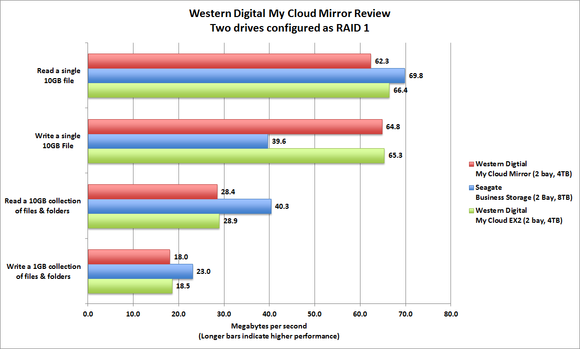
The My Deject Mirror isn't the fastest NAS box we've tested—past a long shot—but information technology offers plenty of features and is very easy to utilise.
If you think you'd benefit from the boosted features that the prosumer-oriented My Cloud EX2 has to offering (dual Ethernet, dual power-supply inputs, and 10 licenses for WD's SmartWare Pro), that box is street-priced just $18 higher than the My Cloud Mirror. The SmartWare Pro licenses are probably worth information technology if you have enough Dropbox chapters to take advantage of that characteristic, but few consumers will. I imagine even fewer volition be able to accept reward of the EX2's additional hardware features.
The original My Cloud is a very adept—if a bit slow—consumer-oriented NAS box, and the My Deject Mirror adds a valuable feature in RAID one. If you employ your NAS to store critical files, this is a solid purchase.

Wd My Cloud Home Vs Mirror,
Source: https://www.techhive.com/article/602462/wd-my-cloud-mirror-review-your-private-cloud-now-with-built-in-redundancy.html
Posted by: ruizhaden1965.blogspot.com
0 Response to "Wd My Cloud Home Vs Mirror"
Post a Comment